???ִ?
4,220-year-old rock art in SW China’s Yunnan reveals early cultural links with Southeast Asia_我的网站

一 |
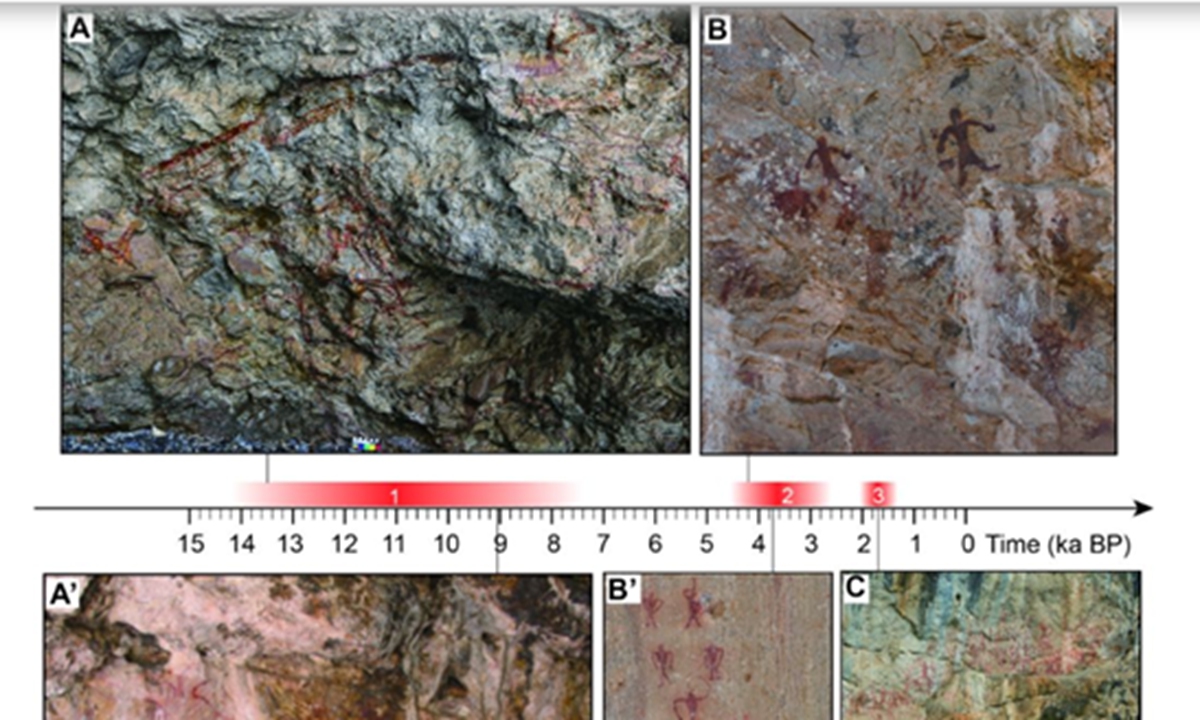
Timeline of the major painted rock art groups in Southwest China: A-A′: Jinsha River rock art; B-B′: Mangguan-Cangyuan rock art; C-C′: Zuojiang rock art Photos: Xinhua
Chinese researchers have obtained the first absolute dates for rock paintings at the Mangguan rock art site in Southwest China's Yunnan Province, pushing the known history of rock art created by prehistoric settled communities in the region back to about 4,220 years ago. The paintings also suggest cultural interactions more than 4,000 years ago between Southwest China and civilizations along the Yellow and Yangtze rivers, as well as possible exchanges with neighboring parts of Southeast Asia, including present-day Myanmar, Thailand and Vietnam, a member of the research team told the Global Times.
The Yunnan Provincial Institute of Cultural Relics and Archaeology, in collaboration with Nanjing Normal University and other institutions, have recently made a significant archaeological breakthrough. Through systematic surveys and uranium-thorium (U-Th) dating at the Mangguan site in Gengma county, the research team obtained the first absolute dates for the site's rock paintings, tracing rock art created by prehistoric settled communities back to around 4,220 years ago.
The findings were recently published in the international journal
Journal of Archaeological Science: Reports.
The Mangguan rock paintings represent one of the best-preserved prehistoric rock art sites in Yunnan. The research team presented high precision U Th dating of carbonate accretions that stratigraphically overlie the painted motifs at the Mangguan site, according to the paper published in the journal.
The dating results show that carbonate deposits overlying a human figure yielded a corrected age of 4,240 ± 19 years before present, confirming that ancient people living in the region had already produced mature figurative art at least 4,220 years ago, Wu Yun, first author of the paper and an associate researcher at the Yunnan Provincial Institute of Cultural Relics and Archaeology, was cited by the Xinhua News Agency report as saying.
Dating results from 11 samples taken from different motifs clustered between about 3,907 and 3,056 years ago. By comparison, the Cangyuan cliff paintings had previously been dated to roughly 3,800 to 2,700 years ago. The Mangguan paintings are therefore significantly older, filling an important chronological gap in the region's artistic record before the Cangyuan phase.
Shao Qingfeng, corresponding author of the paper and a professor at the School of Geography at Nanjing Normal University, told the Global Times that previous estimates dated the Mangguan rock paintings to a little over 3,000 years ago based mainly on imagery and comparisons with similar regional sites. Using microsamples of secondary carbonate deposits overlying the paintings, researchers have now obtained a precise minimum age of about 4,220 years before present without damaging the rock art.
The findings and the establishment of this chronological framework not only strengthen the archaeological foundation for studying rock art in Southwest China, but also provide a direct reference for rock art sites across Southeast Asia that have yet to undergo systematic dating, Shao said.
The findings may also challenge long-held perceptions of Southwest China around 4,200 years ago - roughly the era of the Xia Dynasty (c.2070 BC-C.1600 BC) - and help fill a key gap in understanding the pluralistic yet integrated development of Chinese civilization.
Shao said that while academic research has traditionally focused on the Yellow River and Yangtze River basins as cradles of early Chinese civilization, sites such as Mangguan and Cangyuan show that stable and culturally active communities also thrived in mountainous Southwest China. The newly established rock-art chronology brings an artistic dimension to the broader narrative of China's enduring cultural development.
Moreover, stylistic similarities suggest that Southwest China maintained exchanges with the Yellow River and Yangtze River regions and with early societies in Southeast Asia, providing material evidence of cross-regional interaction more than 4,000 years ago.
。 中新网北京8月22日电 题:义乌,一座城撑开56个民族的“人生舞台”
作者 任德辉 曾玥 张斌 董易鑫
初到义乌,满眼是国际化的街景:招牌上的外语与中文紧密交织,非洲商人在五金档口熟练砍价,中东小伙在餐馆里穿梭忙碌。

二 | 这座浙江中部的县级市,用两三代人的时间,从阡陌农田崛起为全球小商品之都。
然而,比市场更动人的,是这里的“空间感”。

三 | 这座仅1105平方公里的城市容纳了56个民族,让34万余名少数民族群众不仅找到了营生的机会,更找到了安放过往、施展抱负、传承文化的广阔舞台。
航拍义乌市场一景。董易鑫 摄
人尽其才:凡是过往皆为序章
新疆姑娘吐送尼莎肉孜买提(莎莎)的人生履历颇为丰富:学过多种语言,在云南当过警察,回乌鲁木齐做过翻译和老师。当她来到义乌,这些看似零散的经历,在五爱社区找到了“接口”。
五爱社区居住着2240余名各族群众,有来自62个国家的常驻外商。作为辅警,莎莎调解纠纷、消除误会。依托社区成立的“阿依乐·莎莎”石榴红工作室,她时常策划中文课、手工班和AI讲座,促进邻里交往,让归属感在潜移默化中生长。
在义乌,个人的“存量”技能从不被浪费。通过构建“1+3+3+N”民族工作服务体系,这座城市搭建起“石榴红”家园、共富基地、特色工作室等一批民族工作阵地,为不同背景的人才匹配岗位与角色,让每位建设者都能人尽其才、心有所寄。

四 |
蒙古族姑娘塔娜介绍生意情况。董易鑫 摄
赋能梦想:从单打独斗到携手共富
蒙古族姑娘塔娜刚来义乌时,口袋里仅有3000元人民币。

五 |
她进过外贸公司,也自己倒腾过节日用品,生意起步之初,是义乌市民族团结进步促进会接纳了她。在这个圈子里,大家聊的是展位资源,谈的是市场风向,生意与生活上的互帮互助,让她度过了最艰难的起步期。
如今,塔娜已创立多个外贸品牌,产品远销中亚、中东、北非。从曾经的“探路者”变成如今的“引路人”,她将企业打造成“大学生共富实践基地”,手把手教后辈闯荡国际市场。

六 | “我希望把‘义乌温度’带回家乡,带回草原。”塔娜眼中的义乌不缺商机,更不缺情义。
义乌的商业逻辑,不仅在于交易的便捷,还在于生态的包容。在这里,民族同胞从来不是孤立的个体,而是嵌入到全球最大的贸易网络中,共建生态,共享红利。
畲族老板钟敏设计的民族风格创意饰品。董易鑫 摄
延展文化:让“小众”走向世界
在义乌国际商贸城,畲族老板钟敏的饰品店是一处独特的风景。热销品中,既有源自畲族“双凤朝阳”图腾的设计,也有取材自“十二花神”、《白蛇传》及穆桂英传说的创意。这些融合传统文化与现代表达的作品,让世界各地的客商眼前一亮。
“以前我们只卖产品,现在更希望在产品中传递我们的文化。”钟敏感慨。一款“双凤朝阳”饰品,上市仅两个多月就售出700多套。从摆地摊到站上世界舞台,钟敏把生意越做越大的底气在于:义乌不仅拓宽了销售渠道,更让“小众文化”被世界看见。
中欧班列拉长了市场的半径,全球数贸中心加速了货品的流转,而义乌这座城,则延展了文化的边界。
在这里,56个民族的文化自信,随着集装箱一同出海,在世界版图上留下鲜明的中国印记。从就业到乐业,从安居到安心,义乌用一座城的胸怀,撑开了56个民族的人生维度。市场繁荣的沃土上,社会治理与文化包容的新芽正勃勃生长。(完)
【编辑:张令旗】。

七 |
Current article:http://cx4ox4.ruandaimingyunsun.sbs/news/20260826_576113.html
Published on:01:08:27